Every AI tool you use shares one local record of the decisions you've made
and why — and codevira enforces the ones you lock: blocking the
edit before it touches disk in Claude Code, and the commit in
every other editor, because they all commit with git. When it blocks, it
shows you the reasoning.
📁~1 MB per project🔀lives in your repo💻machine-to-machine transfer🔒no cloud⚖️MIT licensed
terminal
# install once$ pipx install codevira
# wire up every AI tool on this machine$ codevira setup
# opt a project in — codevira tracks only what you init$ cd my-project && codevira init
36MCP toolsthe sharpened agent surface
8hook policiesenforcing memory live
~2 mswarm tool callnever blocks your IDE
0cloud dependenciesyour code stays home
At a glance
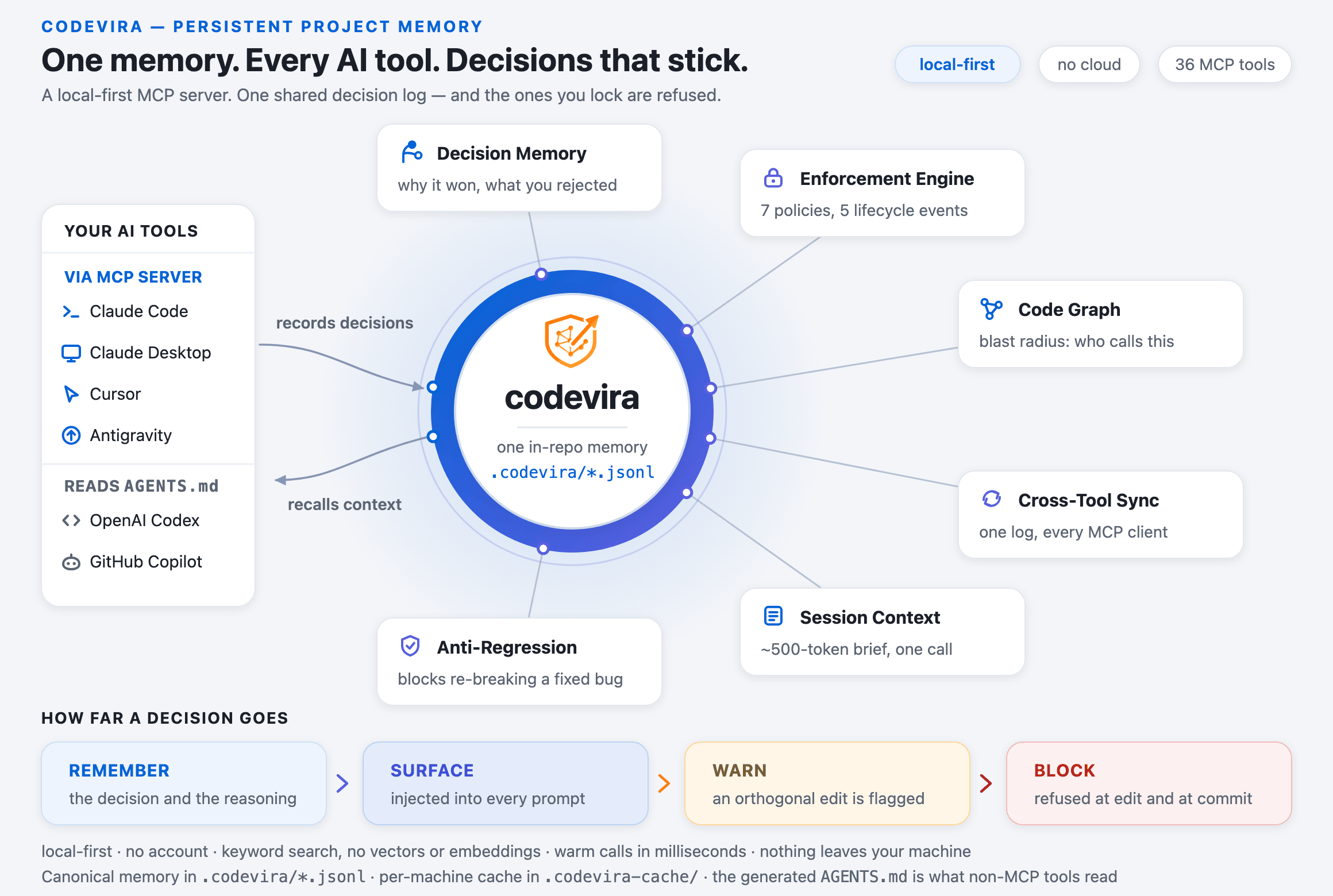
The whole system, one picture
Every AI tool on your machine reads and writes one memory that lives in your
repo — and the decisions you lock escalate from remembered, to surfaced, to refused.
The story
Why codevira exists
01 · THE PROBLEM
Brilliant in the moment. Amnesiac across sessions.
Today's coding agents write code at a senior level — then forget everything when
the session ends. You re-explain the architecture. You re-justify old choices.
And one day an agent confidently reverts the bcrypt decision you made three
months ago, because nothing remembered why.
02 · THE INSIGHT
Remembering isn't enough. Memory must push back.
Notes that nobody reads don't prevent regressions. Codevira sits in the agent's
tool-call path: when an edit would revert a protected decision or re-introduce a
fixed bug, the edit is blocked — with the original reasoning
surfaced, so human and AI can re-decide deliberately.
03 · THE PHILOSOPHY
Your memory belongs to you. Not to one IDE. Not to a cloud.
Project memory lives in .codevira/ — human-readable JSONL,
git-tracked, diffable, ~1 MB. Switch IDEs, switch machines, switch AI vendors:
the memory comes with you. Codevira is built to be a primitive the
whole AI ecosystem can build on, not a feature of one tool.
“
Every AI tool you open reads and writes the same project memory.
What one learns, all of them know — and what you lock, an agent in
Claude Code can't quietly revert.
How it works
Four moments in the life of a memory
Watch the loop: a decision is recorded once, shared everywhere,
enforced forever — and your agents keep learning on top.
1 RecordThe AI captures a decision — one MCP call, ~50 tokens.
2 ShareEvery other AI tool sees it instantly via the same repo files.
3 EnforceMonths later, a careless edit is vetoed before the file changes.
4 LearnSkills and fix history accumulate on top.
claude code
The graph
Memory you can see
Run codevira graph and your project's decision memory renders as an
interactive, fully offline HTML viewer — decisions, files, tags, and the lineage between
them. This is a live miniature. Drag the nodes. Click one.
live · drag & click a node
protecteddecisionfile
D000412
decision
Use bcrypt for password hashing
context
md5 considered and rejected — rainbow-table risk. Re-examine only if
a NIST recommendation changes.
do_not_revertsecurityauth
← click any node to inspect it
Generated per-project by codevira graph — searchable, queryable, zero network.
The wedge
Memory that pushes back
🔒
Decision lock 3.5
Mark a decision do_not_revert and the lifecycle hook vetoes any AI
edit that would undo it. Now content-aware: an edit blocks only when it actually
touches the decision's subject — orthogonal changes pass. Precision, not paranoia.
🛡️
Anti-regression
Commits tagged fix: build a fix-history database. An AI silently
re-introducing a fixed bug gets stopped at the door.
📡
Blast-radius veto
Editing a public signature that 12 files depend on? Codevira shows the callers
and refuses until the change covers them.
🧠
Working memory
Decay-scored intra-session scratchpad. The agent's train of thought survives
context compaction.
⚙️
Skill library
Reusable procedures ("how we rebase here") with git-driven reinforcement —
skills that keep failing get archived automatically.
🔎
Refusals that explain themselves 4.0
When a locked decision blocks an edit, codevira shows why it was made —
the reasoning, the rejected alternatives, the condition to revisit — not just that
a rule exists.
🔗
Survives a team merge 4.0
Records are content-addressed, so a decision's supersession chain stays intact
when two machines merge the same repo — no lost locks, no dangling history.
↩️
One egress door, one undo 4.0
A single audited module is the only thing that can touch the network — a CI test
fails the build if any other file imports an HTTP client. codevira memory undo
rolls back any change.
📦
Machine transfer 3.3
codevira export setup → one archive → codevira import on
the new machine. Memory and learning come with you.
👥
Team-shared memory 3.7.1
codevira init --shared commits the project's decision memory so
teammates on the same repo share it; a built-in git merge driver reconciles
concurrent edits. Default stays per-machine, so unrelated projects never bleed
together. Opt-in.
The hard block now runs two ways. In Claude Code (and Antigravity), a PreToolUse hook refuses the edit before it touches disk. In every other editor — Cursor, Codex, Copilot — an opt-in git pre-commit hook (codevira engine install-git-hook) runs the same engine at the commit boundary, so the veto is physical there too — because every editor commits with git. Without the git hook, those tools still get the decisions as strong AGENTS.md guidance. Shared memory was always universal; as of 4.0, hard enforcement is too — at whatever point each tool reaches.
Cross-IDE
One memory. Every tool.
A decision logged in Claude Code shows up in Cursor. A fix recorded today blocks
the same regression in Cursor tomorrow — through MCP plus an auto-generated
AGENTS.md every modern tool reads natively.
Claude CodeMCP + hooks
CursorMCP + AGENTS.md
CopilotAGENTS.md
Gemini CLIGEMINI.md (opt-in)
CodexAGENTS.md
AntigravityMCP + AGENTS.md
Any MCP clientstandard protocol
codevira setup writes MCP server entries for Claude Code, Claude Desktop, Cursor and Antigravity. Codex and Copilot get the memory the way they already read it — the generated AGENTS.md, no MCP config needed. Gemini CLI isn't a setup target; point it at the memory by opting a project's GEMINI.md in via .codevira/config.yaml.
Why not just…
Your tools alone vs. with codevira
Every IDE has some context feature. None of them persist across tools,
none of them enforce, and the moment you switch IDEs you start from zero.
Capability
IDE alone (chat history, .cursorrules)
Rules files (hand-written CLAUDE.md)
Cloud memory (SaaS recall tools)
Codevira
Memory survives the session
✗
✓
✓
✓
Shared across every IDE
✗
partial
✓
✓
Writes itself (AI-captured)
✗
✗ manual
✓
✓
Enforces — blocks reverting edits
✗
✗ advisory
✗ advisory
✓
Blocks re-introducing fixed bugs
✗
✗
✗
✓
Knows your code graph (blast radius)
✗
✗
✗
✓
Local-first — code never leaves
✓
✓
✗ their cloud
✓
Git-tracked, diffable, reviewable
✗
✓
✗
✓
Learns your preferences from real prompts
✗
✗
partial
✓
Price
—
free
subscription
free · MIT
Codevira doesn't replace your IDE's features — it's the layer underneath all of them.
Token economics
Memory is cheaper than amnesia
Re-explaining your project every session costs real tokens — and real money.
Codevira's read surface is summary-first by design: one ~500-token call replaces the
catch-up conversation entirely.
Illustrative sessions from codevira's own development. The injection side is
just as frugal: ≤3 relevant decisions per prompt, 0 tokens when off-topic, ~30 tokens for your style profile.
Machine to machine
Your memory moves with you
New laptop? Two commands. Project memory already travels with
git clone — the transfer archive brings your cross-project learning
(preferences, learned rules) on top.
old machine → new machine
# old machine — one archive with everything$ codevira export setup
✓ codevira-setup.tar.gz
project memory (.codevira/) + global learning# new machine$ pipx install codevira
$ codevira import codevira-setup.tar.gz
✓ project memory restored
✓ global learning merged— never overwrites what's already there$ codevira init # re-register IDEs, rebuild caches
Moves with gitDecisions, sessions, skills — already in your repo. Clone and they're there.
Moves in the archiveCross-project learning: your preferences and learned rules, merged — not overwritten — into the new machine.
Rebuilt freshCode-graph caches and indexes are machine-local and regenerate on first run. Nothing to migrate, nothing to break.
Integration
MCP is the SDK
Codevira speaks the Model Context Protocol —
the open standard every major AI tool already implements. codevira setup auto-configures
everything it detects; here's what it writes, per tool, if you'd rather do it by hand.
One registration for every project — the server resolves the active project from your editor's workspace roots at runtime. Claude Code also gets lifecycle hooks (PreToolUse / PostToolUse / UserPromptSubmit / Stop / SessionStart) — that's where enforcement lives.
One entry, project resolved from workspace roots at runtime. Cursor also reads the repo's AGENTS.md natively — the decision digest rides along with zero config.
# Codevira is a standard MCP stdio server — any client in any# language connects with the usual MCP SDK. Python example:from mcp import ClientSession, StdioServerParameters
from mcp.client.stdio import stdio_client
params = StdioServerParameters(command="codevira-python", args=["-m", "mcp_server"])
async with stdio_client(params) as (r, w):
async with ClientSession(r, w) as s:
await s.initialize()
ctx = await s.call_tool("get_session_context", {})
36 tools: decisions, roadmap, code graph, working memory, skills, provenance. TypeScript, Go, Rust, Java MCP SDKs all work the same way.
# No SDK at all? The memory is just files in your repo.$ cat .codevira/decisions.jsonl | jq '.decision'"Use bcrypt for password hashing""JSONL is the canonical store; SQLite is a rebuildable index"# Every language that can read a file can read codevira memory.# That's the point.
Git-tracked, human-readable, vendor-neutral. Your memory survives every tool you'll ever switch to.
Capability
Python
TS / JS
Go
Rust
Every other language
Decision capture, search & enforcement
✓
✓
✓
✓
✓
Cross-IDE memory via AGENTS.md
✓
✓
✓
✓
✓
Roadmap, sessions, skills, preferences
✓
✓
✓
✓
✓
Code graph + blast-radius analysis
✓
✓
✓
✓
reads file
Symbol-level query_graph
✓
✓
✓
✓
reads file
Python, TypeScript, JS/JSX, Go, and Rust get full symbol tools; for other languages the agent reads the file directly.
Questions
Frequently asked
What is Codevira?
A governed decision log for AI coding agents. It stores the decisions you make together with the reasoning that justifies them — why a choice won, what you rejected, when to revisit — and enforces the ones you lock across Claude Code, Cursor, Antigravity and every other editor, blocking edits that would revert them or re-introduce a fixed bug. It's not a knowledge base you query; the knowledge is always bound to a decision. Everything is local and lives in your repo.
Does Codevira send my code anywhere?
No. Everything runs locally. Decisions live in <repo>/.codevira/decisions.jsonl and the code graph is a SQLite cache under ~/.codevira/. Search is pure keyword/BM25 (SQLite FTS5) — no embeddings, no model download, nothing phones home. Your code never leaves your machine.
Do I need to run codevira init for every project?
Yes — as of v3.7.0, codevira init is the explicit opt-in. Codevira tracks only the projects you initialize; a project you merely open stays inert (its tools return a "run codevira init" hint and nothing is written), so ~/.codevira/projects/ never fills with projects you never chose. You register the MCP server once, not per project. Set CODEVIRA_AUTO_ADOPT=1 to track every project you open instead.
Does Codevira use embeddings or semantic search?
No, not in the default install. Decision search is pure keyword/BM25 ranking via SQLite FTS5 — no vectors, no sentence-transformers, no ChromaDB, nothing to download on first use. That's why a project's memory is ~1 MB, the production install is ~66 MB, and — with no model to load — warm tool calls return in ~2 ms.
Which AI coding tools does it work with?
Claude Code, Claude Desktop, Cursor, and Google Antigravity via MCP; OpenAI Codex and GitHub Copilot read the generated AGENTS.md natively. One codevira setup configures every tool it detects. As of 4.0, hard enforcement is no longer Claude-Code-only: it blocks the edit before it touches disk in Claude Code and Antigravity (a PreToolUse hook), and the commit in every other editor (an opt-in git pre-commit hook).
How does it block edits in editors other than Claude Code?
Every editor commits with git. codevira engine install-git-hook adds a pre-commit hook that runs the same decision engine as the IDE hook, so a locked decision physically blocks the commit in Cursor, Codex, Copilot — any tool. In Claude Code the block happens even earlier, before the file changes. Without the git hook, other tools still get the decisions as strong AGENTS.md guidance. Override a single commit with git commit --no-verify.
Does it work for a team, or across my machines?
Yes. .codevira/ lives in your repo, so decisions travel with git clone. Records are content-addressed (uid = sha256 of the record), so a decision's supersession chain survives a two-host git merge — no lost locks, no dangling history. codevira export setup carries your cross-project learning (preferences, learned rules) to a new machine, merged rather than overwritten.
How much does it cost?
Free and open source under the MIT license. No account, no API key, no cloud, no subscription — pipx install codevira and you're done.
Give your agents a memory.
Open source, MIT, local-first. Two commands and every AI tool on your machine shares it.